SC603 is a dual serial port module using a Z80 SIO/2, designed for the 40 pin RCBus. It has its own clock oscillator and dividers to set baud rates from 2400 to 115200.
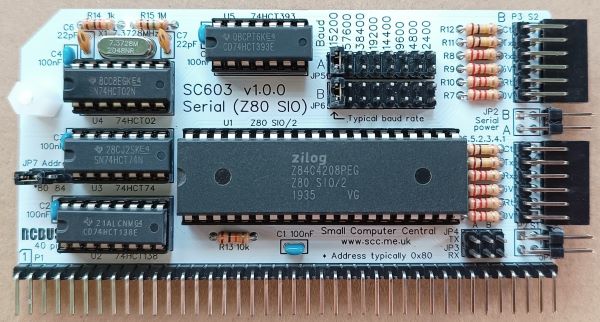
A comparison of serial modules can be found here.
- SC603 – Assembly guide
- SC603 – Compatibility
- SC603 – Parts list
- SC603 – Printed circuit board
- SC603 – User guide
- SC600 series information
- SC600 series support
Downloads
- SC603, v1.0, Kit contents sheet (PDF)
- SC603, v1.0, Schematic (PDF)
- SC603, v1.0, PCB design files (OSHWLab)
- SC603, v1.0, Gerber files (ZIP)
Errata
Nothing known
Suppliers
| Kits | Website | From | Currency |
| Small Computers Direct | SCDirect | UK | GBP |
| Stephen C Cousins | Tindie | UK | USD |
| Small Computer Central | Lectronz | UK | Euro/USD |
| PCBs | Website | From | Currency |
| Small Computers Direct | SCDirect | UK | GBP |
| Stephen C Cousins | Tindie | UK | USD |
| Small Computer Central | Lectronz | UK | Euro/USD |
| Assembled and Tested | Website | From | Currency |
| Not available | |||
| Components | |||
| See parts list |
Tindie does not collect VAT for EU countries
Lectronz does collect EU VAT for orders up to 150 EUR
Parts List
| Reference | Qty | Component |
| PCB | 1 | SC603, v1.0, PCB |
| C1 to C5 | 5 | Capacitor, ceramic, 100 nF |
| C6 and C7 | 2 | Capacitor, ceramic, 22 pF |
| JP1 and JP2 | 2 | Header, male, 2 row x 2 pin, angled |
| JP3 plus JP4 | 1 | Header, male, 2 row x 3 pin, straight |
| JP5 and JP6 | 2 | Header, male, 2 row x 8 pin, straight |
| JP7 | 1 | Header, male, 1 row x 3 pin, straight |
| Jumper | 9 | Jumper shunt |
| P1 | 1 | Header, male, 1 row x 40 pin, angled |
| P2 and P3 | 2 | Header, male, 1 row x 6 pin, angled |
| R1 to R4, R7 to R10 | 8 | Resistor, 2k2, 0.25W |
| R5 and R6, R11 and R12 | 4 | Resistor, 100k, 0.25W |
| R13 | 1 | Resistor, 10k, 0.25W |
| R14 | 1 | Resistor, 1k, 0.25W |
| R15 | 1 | Resistor, 1M, 0.25W |
| S1 and S2 | 2 | Header, female, 1 row x 6 pin, angled |
| Screw (for spacer) | 1 | Machine screw, 6mm, M3 |
| Spacer | 1 | Spacer, 10mm, M3, nylon |
| U1 | 1 | Z80 SIO/2, Z84C4208PEG, or Z80 SIO/2, Z84C4210PEG |
| U2 | 1 | 74HCT138 |
| U3 | 1 | 74HCT74 |
| U4 | 1 | 74HCT02 |
| U5 | 1 | 74HCT393 |
| X1 | 1 | Crystal, 7.3728 MHz |
| IC socket 40-pin U1 | 1 | Socket, DIP, 40 pin |
| IC socket 16-pin U2 | 1 | Socket, DIP, 16-pin |
| IC socket 14-pin U3, U4 and U5 | 3 | Socket, DIP, 14-pin |
Printed Circuit Board
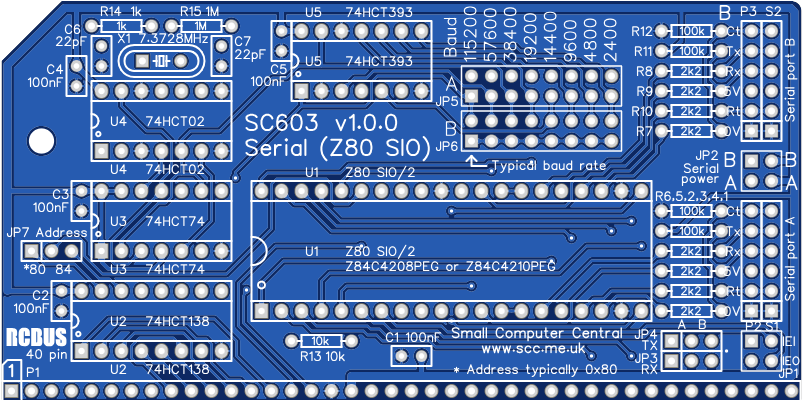
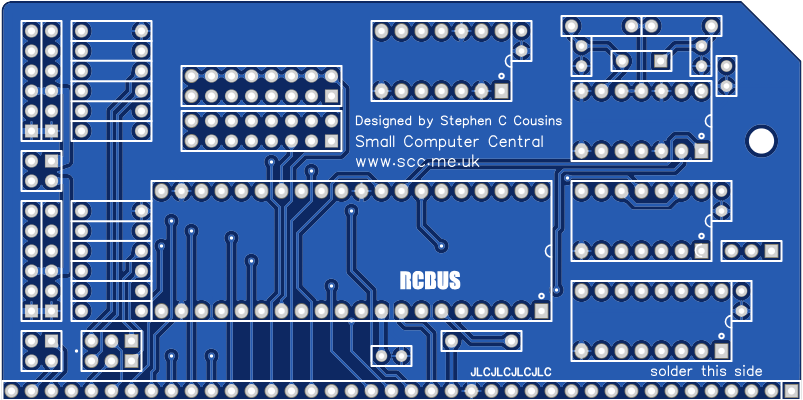
User Guide
SC603 provides two asynchronous serial ports.
The module uses the Zilog Z80 Serial I/O (SIO) integrated circuit which dates back to the late 70s. The port signals are TTL level (5 volts).
The module can be set to a base address of 0x80 or 0x84, allowing two of these modules to be used in the same system, giving a total of 4 serial ports.
To make the serial baud rates independent of the CPU speed (the main bus clock), this module includes a clock oscillator. To overcome the extremely limited baud rate options provided by the Z80 SIO, this module includes clock frequency dividers to generate the required baud rate clocks. This allows each port to be independently set with a simple jumper shunt from 2400 to 115200 baud. These baud rates assume the SIO has its internal divider set to 64. As the baud rates are set in hardware, the software may not be aware of the actual baud rate and might indicate, for example, that it is running at 115200 baud when it is actually set to, say, 9600 baud.
For advanced users with expanded systems this module supports the Z80 interrupt priority daisy chain. Most users can simply ignore this feature. The module has jumpers to allow the interrupt daisy chain signals IEI and IEO to be connected to the bus pins specified in the RCBus specification. Alternatively, the IEI and IEO signals are available on JP1 so these signals can be connected between modules with Dupont wires. The interrupt daisy chain is only required if the system is using Z80 mode 2 interrupts and there is more than one Z80 peripheral chip in use.
The module also has jumpers to allow various serial signals to be connected to the bus RX and TX signals. This allows serial terminal modules, or other serial devices, to be connected to SC603 via dedicated pins on the RCBus.
Jumpers allow serial port devices to be powered from the module or the retro computer to be powered from either serial port.
The serial data format is typically 115200 baud, 8 data bits, no parity, 1 stop bit.
Details about programming a Z80 SIO can be found in the Z80 SIO datasheet (PDF).
Input/output port functions
| I/O Address | Read | Write |
| Configurable *1 base address | Read Z80 SIO/2 | Write Z80 SIO/2 |
| base + 0 | Port A control | Port A control |
| base + 1 | Port A data | Port A data |
| base + 2 | Port B control | Port B control |
| base + 3 | Port B data | Port A data |
- The RCBus I/O base address should be set to match the software you are using. This can be either 0x80 or 0x84.
Jumper options
| Jumper | Function |
| JP 1 | Connects the interrupt daisy chain signals IEI and IEO to bus pins 38 and 39. Alternatively, Dupont wires can be connected to these pins to create a daisy chain. JP 1.1-2 Connect IEI to bus pin 38 JP 1.3-4 Connect IEO to bus pin 39 JP 1.2 IEI input to the SIO JP 1.4 IEO output from SIO The default is jumper shunts not fitted |
| JP 2 | Connects 5 volt power to serial port connectors JP 2.1-2 Connect power to serial port B JP 2.2-3 Connect power to serial port A Do not connect either of these if the system is powered from the backplane |
| JP 3 | Connect RX signal from port A or B to the bus JP 3.1-2 Connect port A’s RX input to pin 36 JP 3.2-3 Connect port B’s RX input to pin 36 Only connect a jumper shunt if the signal is required to link to another module |
| JP 4 | Connect TX signal from port A or B to the bus JP 3.1-2 Connect port A’s TX input to pin 35 JP 3.2-3 Connect port B’s TX input to pin 35 Only connect a jumper shunt if the signal is required to link to another module |
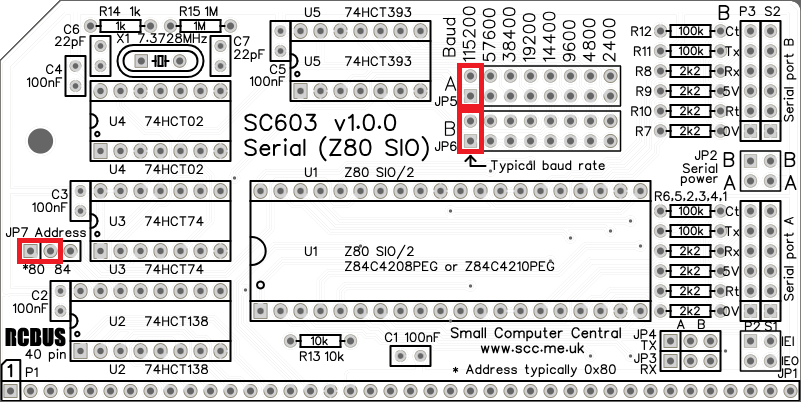
| JP 5 | Set the baud rate for serial port A JP 5.1-2 Baud rate is 115200 JP 5.3-4 Baud rate is 57600 JP 5.5-6 Baud rate is 38400 JP 5.7-8 Baud rate is 19200 JP 5.9-10 Baud rate is 14400 JP 5.11-12 Baud rate is 9600 JP 5.13-14 Baud rate is 4800 JP 5.15-16 Baud rate is 2400 These baud rates assume the SIO’s internal divider is set to 64 The default is a jumper shunt fitted between pins 1 and 2, therefore selecting 115200 baud |
| JP 6 | Set the baud rate for serial port B JP 6.1-2 Baud rate is 115200 JP 6.3-4 Baud rate is 57600 JP 6.5-6 Baud rate is 38400 JP 6.7-8 Baud rate is 19200 JP 6.9-10 Baud rate is 14400 JP 6.11-12 Baud rate is 9600 JP 6.13-14 Baud rate is 4800 JP 6.15-16 Baud rate is 2400 These baud rates assume the SIO’s internal divider is set to 64 The default is a jumper shunt fitted between pins 1 and 2, therefore selecting 115200 baud |
| JP 7 | Set module’s RCBus I/O base address JP 7.1-2 Address is 0x80 (to 0x83) JP 7.2-3 Address is 0x84 (to 0x87) The default is address 0x80 |
Assembly Guide
Below is the suggested order of assembly. A general guide to assembling circuit boards can be found here.

- Resistors R1 to R15
These can be fitted either way around - Sockets S1 and S2
Ensure these are fitted flat against the circuit board - Bus header P1
Make sure the pins are parallel to the PCB so that the board is vertical when it is fitted into a backplane socket - Header pins P2 and P3
Ensure the pins are parallel to socket S1 and S2 - Decoupling capacitors C1 to C5
These can be fitted either way around - Sockets for U1 to U5
Fit such that the notch in the socket matches the curve in the outline on the PCB silkscreen - Crystal X1
This can be fitted either way around - Capacitors C6 to C7
These can be fitted either way around - Jumper pins JP1 and JP2 (each 2×2 pins)
- Jumper pins JP3 plus JP4 (combined 2 x 3 pins)
- Jumper pins JP5 and JP6 (each 2 x 8 pins)
- Jumper pins JP7 (1×3 pins)
- Insert the integrated circuits into their sockets
Make sure the notch in the component is at the end indicated by the notch in the socket and the curve on the PCB silkscreen - Fit the nylon spacer in the mounting hole
Fit jumper shunts in the positions shown below. All other jumpers are optional and should only be fitted if the feature is required.
Compatibility
This module conforms to the RCBus specification v1.0 for RCBus-2014 (40-pin bus) and RCBus-Z80 (40-pin bus).
The RCBus specification includes RCBus-2014 (both RC2014 standard 40-pin bus and RC2014 enhanced 60-pin bus) and also the full 80-pin RCBus. The 80-pin RCBus provides support for advanced Z80 features, such as the interrupt daisy-chain, as well as support for other processor families.
The table below indicates electrical compatibility with each backplane type (40, 60 and 80 pin)

| Backplane | ? | Compatibility notes |
| RCBus 80-pin |  | Fully supported |
| RCBus 60-pin (RC2014 enhanced) | | Fully supported |
| RCBus 40-pin (RC2014 standard) | | Fully supported |
Notes
- This product is designed for hobby use and is not suitable for industrial, commercial, or safety-critical applications.
- The product contains small parts and is not suitable for young children.
- RC2014 is a trademark of RFC2795 Ltd.
 Small Computer Central