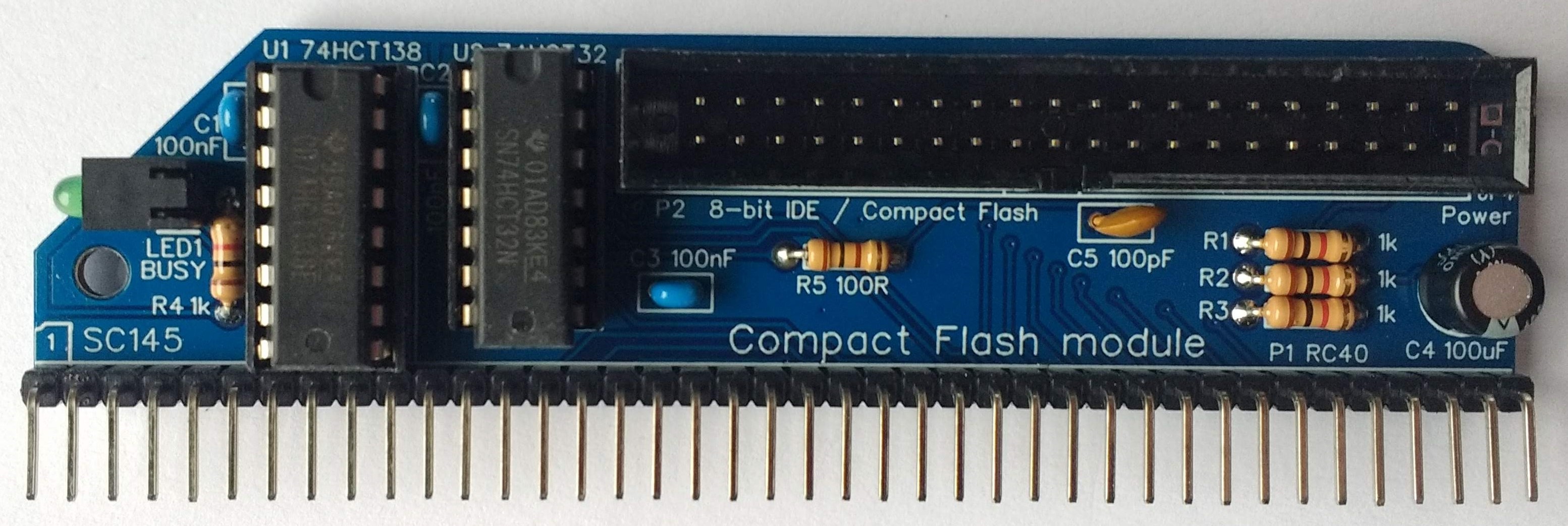
SC145 is a Compact Flash interface designed for RC2014.
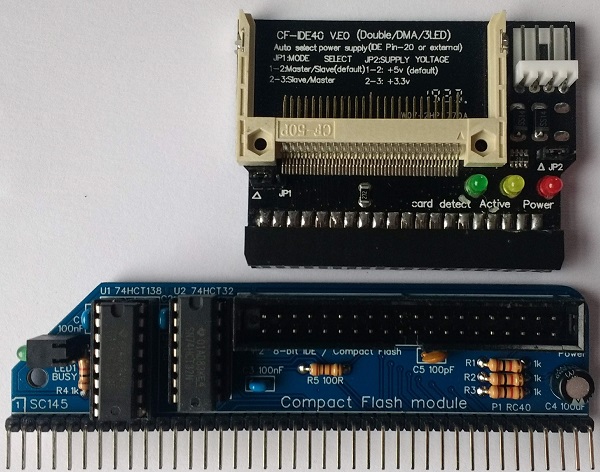
See notes about the Compact Flash adapter.
Documentation
Downloads
Suppliers
| Kits | Website | From | Currency |
| Small Computers Direct | SCDirect | UK | GBP |
| Stephen C Cousins | Tindie | UK | USD |
| PCBs | Website | From | Currency |
| Small Computers Direct | SCDirect | UK | GBP |
| Stephen C Cousins | Tindie | UK | USD |
| Assembled and Tested | Website | From | Currency |
| Not available | |||
| Components | |||
| See parts list |
Description
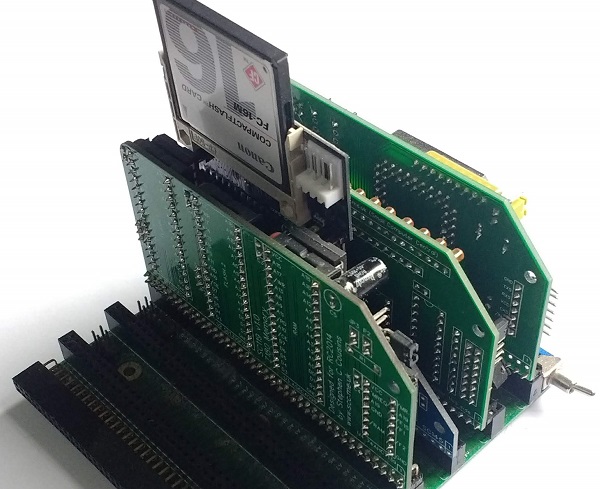
This module provides an 8-bit IDE interface via a 40-pin male header. In theory, you could connect other IDE devices, not just the recommended Compact Flash adapter module (shown right).
As this is a very simple interface, which uses the processor bus directly, without buffering, the IDE interface should not be extended for more than a few inches, and only carefully selected devices should be connected. In general, it is best to only use this interface to connect a Compact Flash card.
The card has the following features:
- RC2014 compatible (low profile module)
- Tight address decoding
- Optional power to IDE connector
- Activity LED
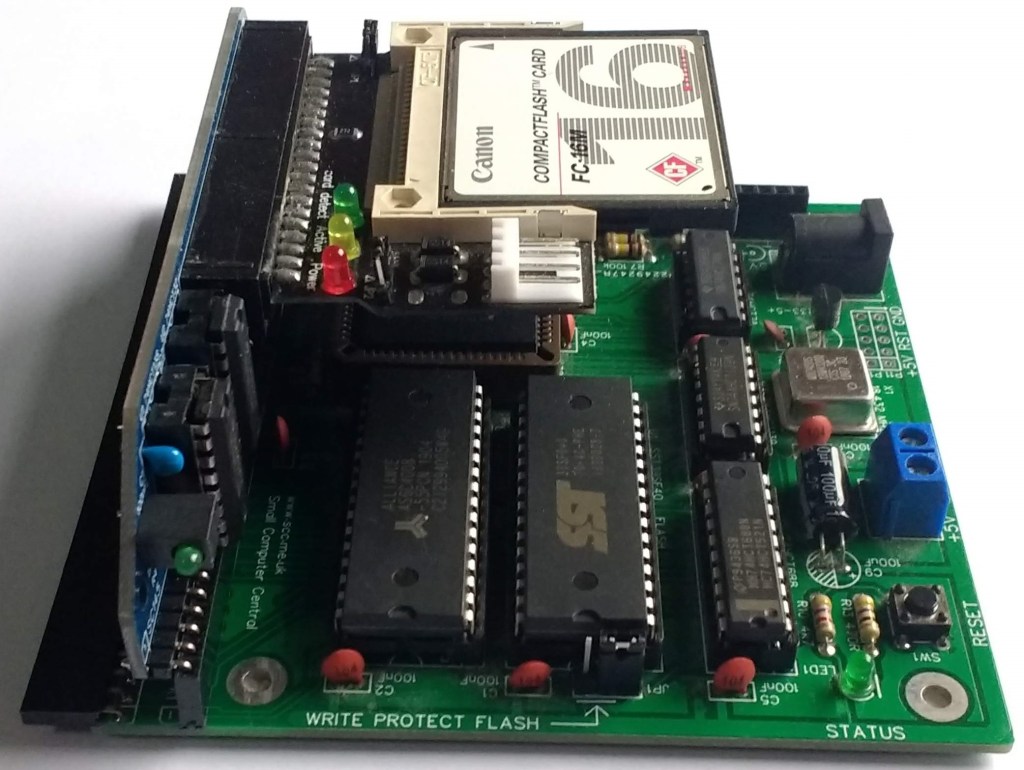
The module can be built with the Compact Flash either horizontal or vertical.
User Guide
This module provides an 8-bit IDE interface via a 40-pin male header. In theory, you could connect other IDE devices, not just the recommended Compact Flash adapter module (shown above).
As this is a very simple interface, which uses the processor bus directly, without buffering, the IDE interface should not be extended for more than a few inches, and only carefully selected devices should be connected. In general, it is best to only use this interface to connect a Compact Flash card.
It is recommended that this module be placed close to the CPU.
Not all Compact Flash cards are compatible with this simple 8-IDE interface. Older cards tend to be best. Large capacity, more modern cards are designed for very fast operation. This means very sharp edges on signals generated by the Compact Flash card. These edges can cause reliability problems with this simple, bus-based interface.
Address
The module has a fixed address, 0x10 to 0x17 (it occupies 8 I/O addresses).
Power
The device plugged into P2 (20 pin, 8-bit IDE) can be either self-powered or can take power from SC145. The recommended Compact Flash adapter module must be powered from SC145.
As it is very likely the connected device will need to be powered from SC145, JP1 has a track connecting its two pads. Thus the jumper header and jumper shunt are optional. If fitted, the track between the pads of JP1 must be cut. This track is on the solder side of the PCB.
Software
This module is software-compatible with the official RC2014 Compact Flash Module. Thus it can be used with any ‘standard’ RC2014 software, including versions of CP/M.
If the system is running RomWBW (which includes CP/M) the Compact Flash can be initialised for use with the CLRDIR command. CP/M does not need to be installed on the Compact Flash card as RomWBW is a ROM-based operating system that includes CP/M. With recent releases of RomWBW you may need to use FDISK80 first.
If the system is running plain CP/M (not RomWBW) the Compact Flash card needs to be prepared before use. Instructions to install CP/M 2.2 onto a Compact Flash card can be found here.
If you are using the Small Computer Monitor firmware then CP/M can be loaded and started from a suitably prepared Compact Flash card with the command “CPM”.
Parts List
| Reference | Qty | Component |
| PCB | 1 | SC145, v1.1, PCB |
| C1 to C3 | 3 | Capacitor, ceramic, 100 nF |
| C4 | 1 | Capacitor, electrolytic, 100 µF |
| C5 | 1 | Capacitor, ceramic, 100 pF |
| JP1 | 0 | Linked with thin track Header pins not included in the kit |
| LED1 | 1 | LED, green, 3mm, angled |
| P1 | 1 | Header, male, 1 x 40 pin, angled |
| P2 | 1 | Box header, 2 x 20 pin, angled *, or Box header, 2 x 20 pin, straight *, or Header, male, 2 x 20 pin, angled, or Header, male, 2 x 20 pin, straight * included in the kit |
| R1 to R4 | 4 | Resistor, 1k, 0.25W |
| R5 | 1 | Resistor, 100R, 0.25W |
| U1 | 1 | 74HCT138 |
| U2 | 1 | 74HCT32 |
| IC socket 14-pin U2 | 1 | 14-pin PDIP socket |
| IC socket 16-pin U1 | 1 | 16-pin PDIP socket |
PCB
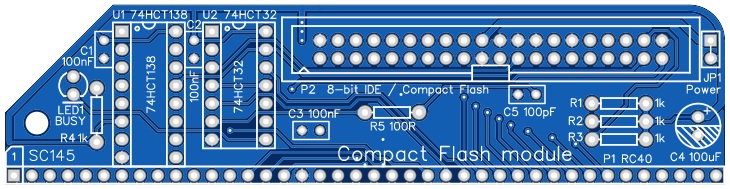
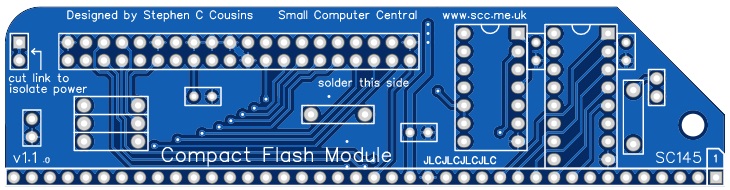
| Links |
| SC145, v1.1, PCB design files (OSHWLab) |
| SC145, v1.1, Gerber files (ZIP) |
| Supplier | Website | Ships from |
| Stephen C Cousins | Tindie | UK |
| pcb4diy | eBay | Germany |
| pcb4diy | pcb4diy.de | Germany |
Assembly Guide
Experienced builders should decide on the preferred orientation of the Compact Flash adapter and then just go ahead and populate the board. There shouldn’t be any surprises to catch you out.
This guide assumes you are familiar with assembling circuit boards, soldering, and cleaning. If not, it is recommended you read some of the guides on the internet before continuing.
First check you have all the required components.
Before assembling it is worth visually inspecting the circuit board for anything that looks out of place, such as mechanical damage or apparent manufacturing defects.
If you have a multimeter that measures resistance or has a continuity test function, check there is not a short on the power supply tracks. Connect the probes to each terminal of one of the capacitors, such as C1. This should be an open circuit, not a short circuit.
The picture below shows what a completed SC145 should look like.

Resistors
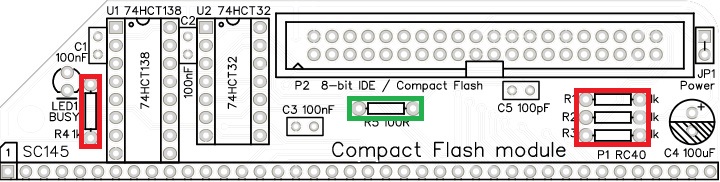
Fit and solder the 1k resistors, R1 to R4, shown below in red.
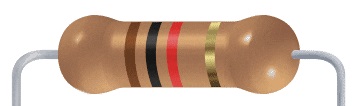
Fit and solder the 100R resistor, R5, shown below in green.
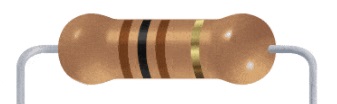
Resistors can be fitted either way around, as they are not polarity dependent.
IC sockets
Fit and solder the IC sockets.
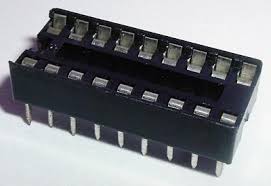
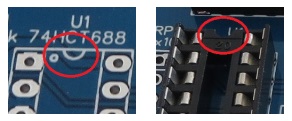
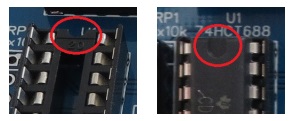
Be sure to fit them with the notch matching the legend on the circuit board, so you do not end up fitting the IC the wrong way around too.

Light Emitting Diode (LED)
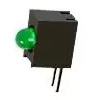
Fit and solder green LED, LED1.
If using an angled LED the polarity is predefined and matches the PCB.
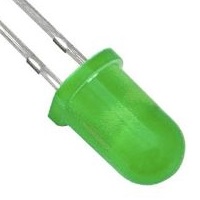
If using standard LEDs care must be taken to ensure they are fitted the correct way around.
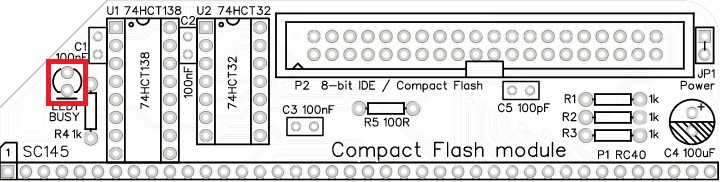
It is important to fit the LED the correct way around. LEDs usually have a small flat side to indicate the cathode (the negative end). This should be positioned to match the flat side shown on the circuit board (illustrated to the right). Also, the cathode pin on the LED is usually shorter than the other pin (the Anode).

Capacitors (100 nF)
Fit and solder the 100 nF cacacitors, C1 to C3.
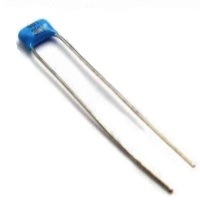
These can be fitted either way around as they are not polarity dependent.
The exact value of this component is not critical. The use of very cheap capacitors within the range of about 30 to 200 nF is acceptable.

Capacitor (100 pF)
Fit and solder the 100 pF capacitor, C5.
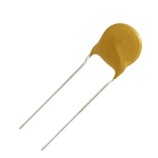
These can be fitted either way around as they are not polarity dependent.

Single row angled header pins
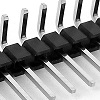
Fit and solder the single row angled header pins, P1.

Capacitor (100uF)
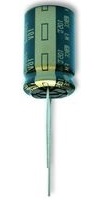
Fit and solder capacitor, C4.
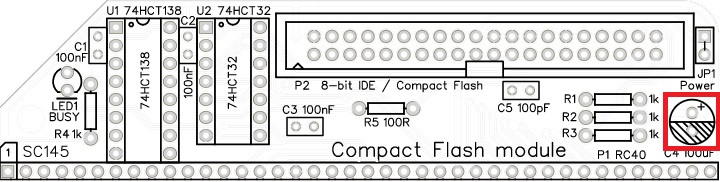
It is important to fit this capacitor the right way around. The negative terminal is indicated with a ‘minus’ sign, as illustrated to the right. The negative terminal also has a shorter lead.
The silkscreen has a plus sign for the positive terminal and a hashed area for the negative terminal.
IDE connector
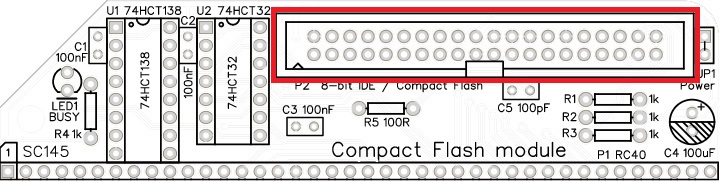
Fit and solder the IDE connector, P2. This can either be right-angled or straight, and either a box header or header pins. The box header is recommended.
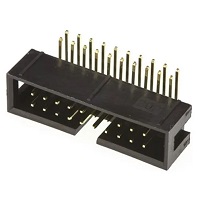
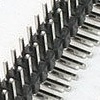
IMPORTANT: Note the position of the key slot on the box header. This must match the position indicated on the circuit board.
Fit a straight header if you want the Compact Flash card to be parallel with the backplane. This is likely to be the best option if you are using the module with a motherboard-style system, such as SC114, SC126, and SC130.
Fit an angled header if you want the Compact Flash card to be perpendicular to the backplane. This option means the Compact Flash is mounted very high above the backplane, but it can be installed in the middle of a backplane. In this case, the Compact Flash card faces the solder side of the module which may not be very visually pleasing.
Inspection
Remove any solder ‘splats’ with a brush, such as an old toothbrush.
Visually inspect the soldering for dry joints and shorts.
Clean the flux off with suitable cleaning materials.
Visually inspect again. The importance of visual inspection can not be overstated.
Quick Test
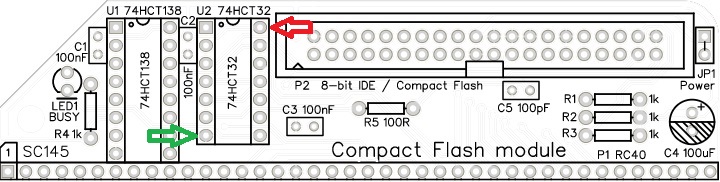
Check for a short on the power supply tracks by measuring the resistance between IC U2 pin 14 and U1 pin 7 (indicated below). This should be an open circuit, not a short circuit. If you are using a digital meter set to measure resistance it will likely take a few seconds for the reading to stabilise as there are now capacitors on the power lines. A reading of more than 100k Ω (100000 ohms) is acceptable.
Integrated circuit
Insert the integrated circuits (ICs) into their sockets, taking care to insert them the right way around, as illustrated below. Be careful not to bend any legs over. ICs are usually supplied with the legs slightly spread outwards so you may wish to bend them to the 90-degree position before inserting them into their sockets.
You are now ready to give it a try.
Notes
- This design is made in accordance with the “designed for RC2014” labelling scheme.
- RC2014 is a trademark of RFC2795 Ltd.
- This product is designed for hobby use and is not suitable for industrial, commercial or safety-critical applications.
- The product contains small parts and is not suitable for young children.
 Small Computer Central